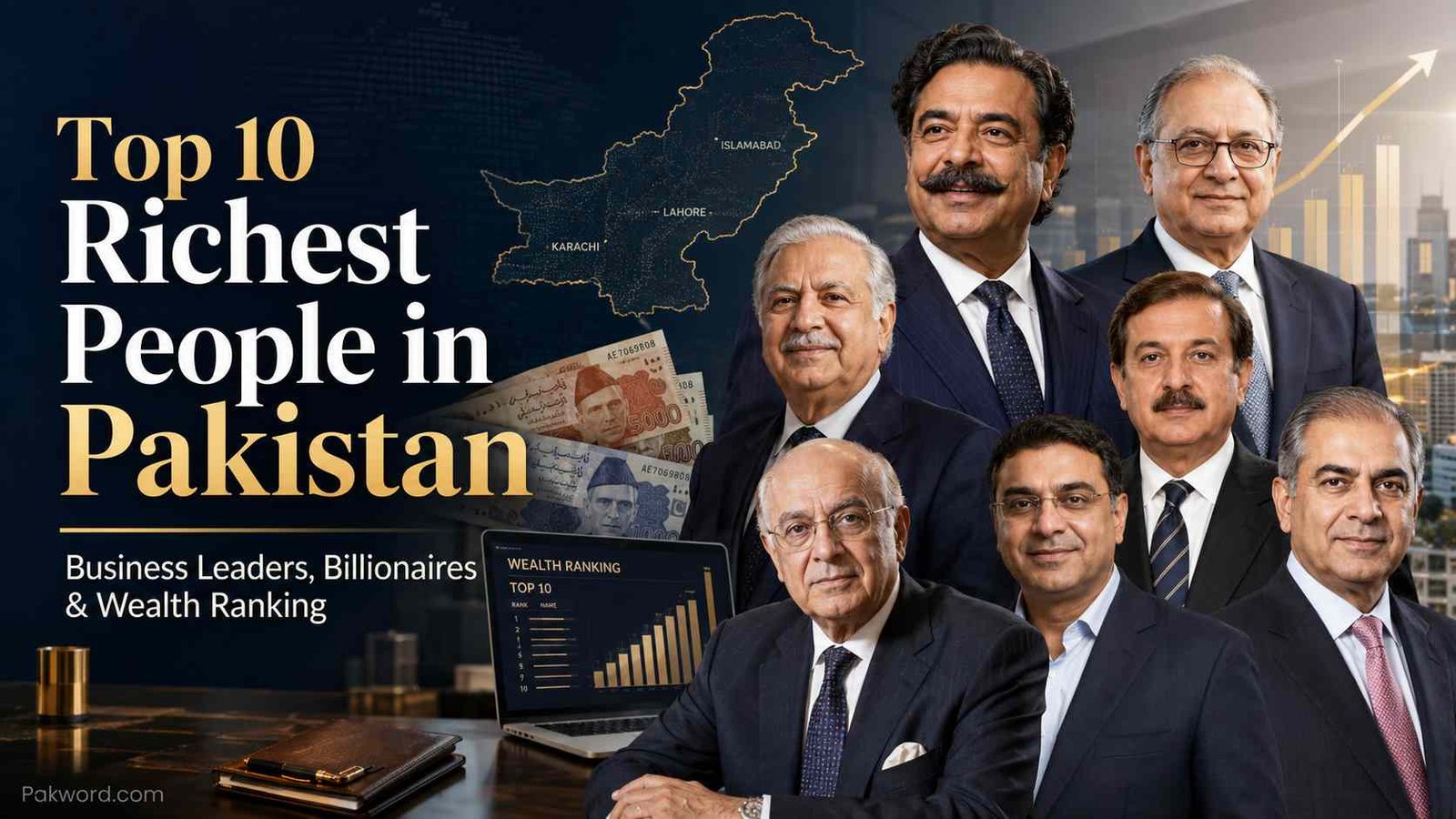
That difference matters. Some names are backed by Forbes or major rich lists. Others are powerful business figures whose family companies are large, but their personal wealth is not publicly confirmed.
Why Is The Top 10 Richest People In Pakistan 2026 List Hard To Verify?
Pakistan’s richest people list is difficult because much of the country’s wealth sits inside private companies, family-owned groups, real estate, inherited businesses, offshore assets, and unlisted holdings. Unlike the United States, Pakistan does not have a regularly updated public wealth index for every major business family.
Forbes does publish a global billionaires list, and Shahid Khan appears in Forbes’ 2026 billionaire coverage with a reported net worth of about $15 billion and a source of wealth listed as automotive and sports-related assets. But Forbes does not give Pakistan a clean “top 10 richest people in Pakistan” list every year.
That is why many local websites repeat old figures without checking whether the person is still alive, whether the wealth belongs to an individual or a family, and whether the value is based on listed shares, company assets, property, or simple internet estimates.
Who Is The Richest Pakistani In 2026?
The richest Pakistan-born person in 2026 is Shahid Khan, also known as Shad Khan. He was born in Lahore and later built his fortune in the United States through Flex-N-Gate, an auto parts company. He is also known for owning the Jacksonville Jaguars, Fulham F.C., and other sports-related interests. Forbes’ 2026 top 200 billionaires coverage listed Shahid Khan at $15 billion.
For Pakistani readers, the important point is this: Shahid Khan is Pakistan-born, but his business empire and residence are mainly linked to the United States. So if someone asks, “Who is the richest person in Pakistan?” the cleaner answer is usually split into two parts.
Shahid Khan is the richest Pakistan-born billionaire.
Mian Muhammad Mansha is often described as one of the richest Pakistan-based business figures because of Nishat Group, MCB Bank, DG Khan Cement, textiles, energy, and other business interests. Forbes still has an older profile for Mian Muhammad Mansha, but the visible Forbes search result relates to his 2010 billionaire listing, not a fresh 2026 ranking.
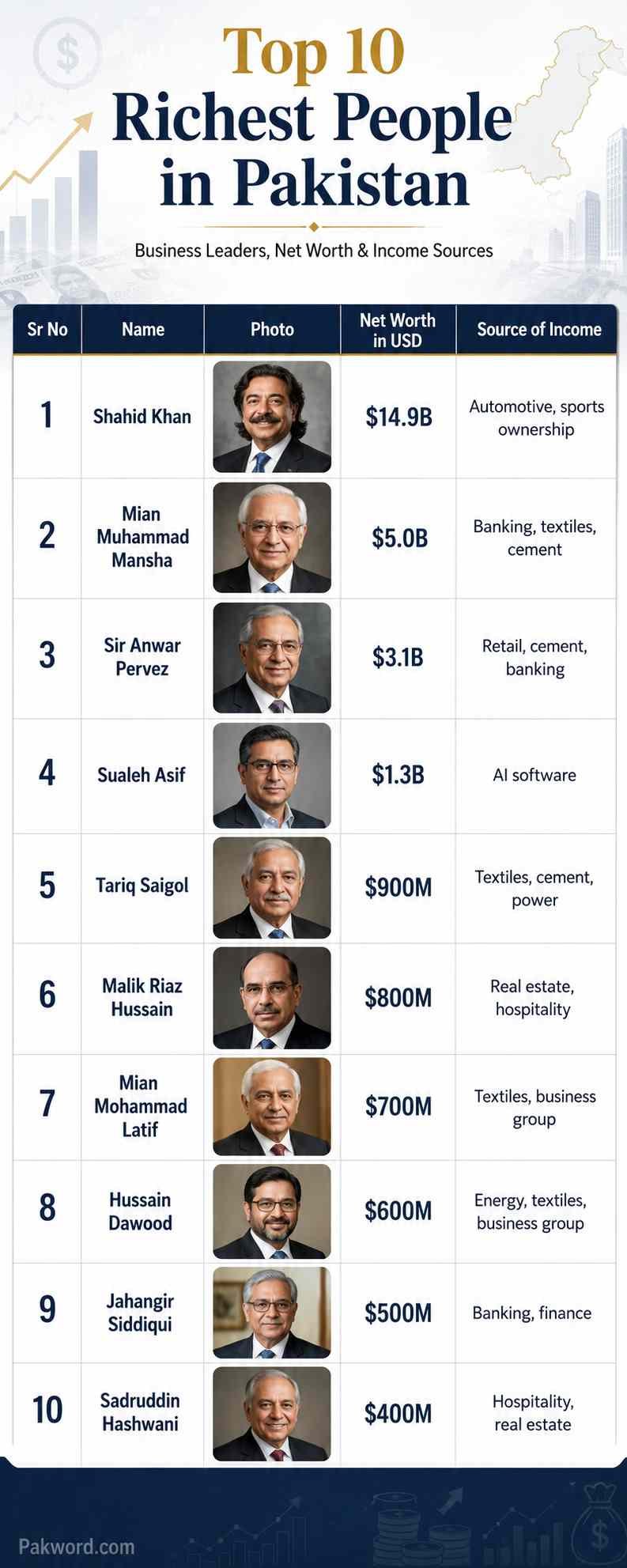
What Is The Top 10 Richest People In Pakistan 2026 List?
This is the safest working list for 2026, based on public visibility, billionaire references, major business holdings, and available verification. Exact rankings after the first few names should not be treated as audited.
| Rank | Name | Main wealth source | Verification status |
|---|---|---|---|
| 1 | Shahid Khan | Flex-N-Gate, Jacksonville Jaguars, Fulham F.C. | Strong Forbes-backed billionaire data |
| 2 | Mian Muhammad Mansha | Nishat Group, MCB Bank, textiles, cement, banking | Widely cited, older Forbes profile |
| 3 | Sir Anwar Pervez | Bestway Group, Bestway Cement, UBL links | UK rich list and business records |
| 4 | Qasar Younis | Applied Intuition, AI vehicle software | Forbes profile and company valuation data |
| 5 | Sualeh Asif | Anysphere, Cursor AI software | Forbes profile and Pakistani media reports |
| 6 | Sadruddin Hashwani | Hashoo Group, hospitality, oil and gas | Business group verified, net worth less clear |
| 7 | Hussain Dawood | Engro, Dawood Hercules, family holdings | Business role verified, personal wealth unclear |
| 8 | Muhammad Ali Tabba | Yunus Brothers Group, Lucky Cement, textiles, power | Business role verified, personal wealth unclear |
| 9 | Habib family / House of Habib | Banking history, industry, tiles, autos, finance | Family group verified, individual ranking unclear |
| 10 | Major real estate and industrial families | Property, construction, industry, private groups | Often cited, but estimates need caution |
This version is more honest than a fake exact ranking. A clean article should not pretend that every figure has a fresh Forbes-style number.
Is Shahid Khan The Richest Man Connected To Pakistan?
Yes, Shahid Khan is the richest Pakistan-born person with strong international billionaire recognition in 2026. His wealth is not mainly from Pakistan’s local economy. It comes from the auto parts business in America and major sports ownership.
Forbes’ 2026 top billionaires coverage listed him with $15 billion, while other Forbes search results also connect him to the 2026 list of richest sports team owners. That makes him the most verifiable name for this topic.
But calling him simply “Pakistan’s richest man” can confuse readers. He is Pakistani-born and globally known, but his wealth is mostly US-based. For a Pakistan-resident or Pakistan-based business ranking, Mian Muhammad Mansha and other local industrial families become more relevant.
Where Does Mian Muhammad Mansha Stand Among Pakistan’s Wealthiest People?
Mian Muhammad Mansha is one of the most important names in any Pakistan richest people list. He is linked with Nishat Group, MCB Bank, DG Khan Cement, textiles, power, hotels, and other investments. His public image is that of a major Pakistan-based industrialist rather than a social media billionaire figure.
The caution is that fresh, verified personal net worth figures are difficult to confirm. Forbes has an older Mian Muhammad Mansha profile connected to the 2010 billionaires list. That confirms he has been internationally recognized in the past, but it does not automatically prove a current 2026 figure.
For Pakword readers, this is the fair wording: Mian Muhammad Mansha is one of Pakistan’s richest and most influential business figures, but current online net worth estimates should be treated carefully unless backed by a reliable financial source.
Who Is Sir Anwar Pervez In Pakistan’s Richest People List?
Sir Anwar Pervez is a Pakistan-born British businessman and the founder of Bestway Group. His business story is often mentioned because he moved to the UK and built a major wholesale, pharmacy, banking, and cement-linked group. Bestway’s own history says Sir Anwar Pervez migrated from his village in Pakistan to the UK and later built the Bestway business.
Older rich list reporting placed him among the wealthiest Pakistan-born British businessmen. Dawn reported in 2018 that Gujar Khan-born Sir Anwar Pervez appeared on the Sunday Times rich list with a net worth of £3.09 billion.
For 2026, he remains a major name, but exact current wealth needs fresh Sunday Times or comparable rich-list confirmation before using a hard number.
Why Are Qasar Younis And Sualeh Asif Important In 2026?
The 2026 list has a new technology angle. Earlier Pakistani richest people lists were usually full of banking, textiles, cement, property, and family conglomerates. Now AI and software founders are entering the conversation.
Qasar Younis is the Pakistani-American cofounder and CEO of Applied Intuition, a vehicle software and autonomy company. Forbes has a profile for him, and Forbes’ company coverage says Applied Intuition was valued at $15 billion and that Younis became a billionaire after the company’s valuation rose.
Sualeh Asif, originally from Karachi, is linked with Anysphere, the company behind Cursor. Forbes’ visible profile result says Cursor reached a $29.3 billion valuation in November 2025 after a major funding round. Business Recorder also reported that Sualeh Asif, originally from Karachi, cofounded Cursor with MIT friends and had a reported net worth of $1.3 billion.
These names matter because they show a shift. Pakistani-origin wealth is no longer only about land, mills, cement, banking, or trading. Global AI companies can create billionaires much faster, but their valuations can also change faster.
Why Are Some Pakistani Billionaire Lists Not Reliable?
Many online “top 10 richest person in Pakistan” posts have a common problem: they copy figures from old articles and present them as current. Some also mix living people, families, politicians, company groups, and private real estate owners into one list without explaining the difference.
A serious ranking should ask three questions before naming someone:
Who owns the asset personally?
Is the wealth based on listed shares, private company value, land, or rumor?
Is the figure current, or copied from an older list?
This is why political names and real estate names should be handled carefully. Pakistan has many wealthy and powerful families, but wealth claims around politicians and private landowners often come without audited public data. A reader should not treat every viral list as fact.
What Is The Difference Between Forbes Billionaires And Local Richest Lists?
Forbes uses its own methods to estimate billionaire wealth, including public shareholdings, private company valuations, assets, debt, and other available information. Even Forbes estimates can move quickly because market prices change.
Local Pakistani lists often do not explain their method. They may use “assets,” “family wealth,” “company market cap,” or “rumored property value” as if all are the same thing. They are not.
For example, if a person leads a company worth billions, that does not mean the person personally owns the full company value. If a family owns a business group, that wealth may be split between many relatives. If a company is private, its real market value is harder to confirm.
That is why Shahid Khan, Qasar Younis, and Sualeh Asif are easier to discuss when Forbes or major business reporting gives recent figures. Pakistan-based private business families need more cautious language.
Who Are The Major Pakistan-Based Business Names To Know?
Some names are important because of their business groups, even when exact personal ranking is not verified.
Sadruddin Hashwani is the founder and chairman of Hashoo Group. Hashoo Group says it was established in 1960 and became a diversified international business portfolio, with interests including hospitality and other sectors.
Hussain Dawood is chairman of Engro Holdings and Engro Corporation. Engro’s own leadership page describes him as a businessman and philanthropist who has driven group investments since 2002. Reuters has also described Engro as one of Pakistan’s largest conglomerates with businesses across energy, fertilizer, telecommunications, and consumer goods.
Muhammad Ali Tabba is strongly linked with Yunus Brothers Group and Lucky Cement. Lucky Cement’s official profile says he began his journey with Yunus Brothers Group in 1991 and that YBG has interests in building materials, chemicals, pharmaceuticals, energy, textiles, automotive, and real estate development.
House of Habib is another major Pakistani business family group. Its official website describes a long history across different industries, including private investment in ceramics and other sectors.
These names belong in a “wealthiest business families” discussion. But they should not be given fake exact personal net worth figures unless a reliable current source supports those numbers.
What Is The Top 1% In Pakistan?
The “top 1% in Pakistan” does not mean only billionaires. It means the richest 1% of the population by income or wealth, depending on the method used.
World Inequality Database describes itself as an open source for inequality data that combines national accounts, surveys, and fiscal data to estimate income and wealth distribution. Business Recorder reported, citing World Inequality Lab findings, that Pakistan’s richest 10% held 59% of total wealth, while the top 1% accounted for 24%.
That does not give a simple rupee threshold for every household. It tells us something more useful: wealth in Pakistan is highly concentrated. A person may be in the top 1% by income and still be far away from billionaire status.
Who Will Be The Richest Person In 2026?
For Pakistan-connected wealth, the strongest current answer is Shahid Khan, based on Forbes’ 2026 coverage.
For Pakistan-based business wealth, Mian Muhammad Mansha remains one of the strongest names, but the exact 2026 figure needs careful verification. For future growth, technology founders like Qasar Younis and Sualeh Asif may become even more prominent because AI company valuations can rise quickly.
The risk is the same: startup valuations can also fall. A funding round may make a founder a billionaire on paper, but private-company wealth is less liquid than cash or public shares.
Should Readers Trust Every Top 100 Richest Man In Pakistan List?
No. Readers should be careful with any “top 100 richest man in Pakistan” list that gives exact figures without explaining the source.
A reliable list should clearly separate:
Verified billionaire data from Forbes or a major rich list
Pakistan-born global billionaires from Pakistan-resident business figures
Individual wealth from family wealth or company value
Old estimates from current 2026 data
If a list does not make these differences clear, it may still be interesting, but it should not be treated as a confirmed financial record.
What Should You Remember Before Sharing A Pakistan Richest People List?
The safest 2026 answer is that Shahid Khan is the richest Pakistan-born person with strong Forbes-backed data, while Mian Muhammad Mansha, Sir Anwar Pervez, Qasar Younis, Sualeh Asif, Sadruddin Hashwani, Hussain Dawood, Muhammad Ali Tabba, and leading Pakistani business families belong in the wider conversation about Pakistan’s richest people.
The honest ranking is not always the most viral one. But for readers, accuracy matters more than a flashy number. Pakistan’s real wealth story is not only about one billionaire. It is about old industrial families, banking groups, cement and textile empires, real estate wealth, and now a new wave of Pakistani-origin technology founders.